


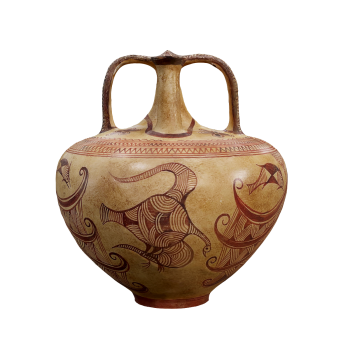
3D model of a replica of a late Mycenaean stirrup jar
It is a replica from the late Mycenaean civilization in Greece (approximately 1400 BC to 1100 BC). This type of jar is named after its top stirrup shaped handle and nozzle configuration. The symmetrical composition and abstract representation of marine life are typical Mycenaean styles. This type of jar is usually used for transporting liquids. The decoration on the jar and the dynamic octopus pattern prove the importance of the ocean as a means of communication and a source of food and wealth. It is even possible that this jar was designed for the export of oil from the region, and it is a celebration of the Mycenaean people's maritime strength and enjoyment of the ocean and its life giving properties.

Linear octopus patterned stirrup jar
It is a type of pottery from the late Minoan civilization on the island of Crete in ancient Greece. This jar is named after its unique stirrup shape and is decorated with a linear octopus pattern. The Minoan civilization, approximately from 2000 BC to 1450 BC, was one of the earliest civilizations in Europe, known for its complex palaces, religious beliefs, and artistic achievements. The stirrup jar is one of the common pottery items in the Minoan culture, typically used for storing food and liquids. The shape design makes them easy to carry and use, while the decorative patterns reflect the Minoan people's worship of nature and marine life. It is the material cultural heritage of the Minoan civilization.

3D model of Mycenaean civilization stirrup jar replica
It is a type of imitation stirrup jar originating from Cyprus, whose prototype belongs to the Mycenaean civilization/Late Hradic III period (approximately 1400 BC to 1100 BC). Named after its top stirrup shaped handle and spout configuration. In ancient times, this type of jar was often used to transport wine and olive oil in the Mediterranean region due to its ease of carrying and storage, as well as its design that would not overflow. Decorations are usually symbolic and reflect the culture and aesthetics of the society at that time. Decorations with fish and birds as the main themes may be related to the connection between the ocean and nature, and these elements are very common in Mycenaean art.

Popular Models

Random Model

Apple Watch 7
1185 View



Catfish Specimen
579 View


Linhai Jinshan Xiaowenfeng Pagoda
1364 View


Prototype Geometric Lequitos Bottle
751 View

BMW M2 two door coupe
1156 View

Ferdinand Raimonde
862 View